Blog
Resume Builder Scam
Resume Builder Scam: The $2.95 Trial Trap Exposed

Updated on Feb 21, 2026
Many resume builders use deceptive pricing patterns: no pricing pages, $2.95 trials that become $29.95/month (or even $39.95/month) subscriptions, build-first-pay-later traps, free downloads that are only unusable text files, and intentionally difficult cancellation. This guide shows you what to watch for and how to protect yourself.
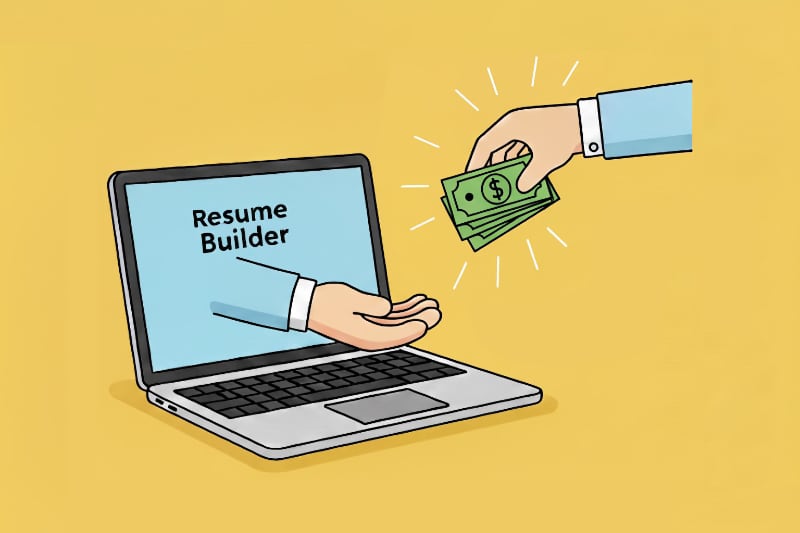
Why People Think Resume Builders Are Scams
When it comes to resume builders, many users instinctively label them as "scams." This reputation didn’t appear out of nowhere. In fact, it developed for three main reasons:
Shady pricing tactics are widespread, not isolated. The majority of resume builders use similar pricing tactics such as $2.95 trials, hidden subscriptions, and download paywalls. When nearly every platform follows the same playbook, the entire industry earns a negative reputation.
People only share stories when something goes wrong. Job seekers who have a smooth experience rarely post about it. But negative experiences spread quickly on Reddit, LinkedIn, and review sites, amplifying the perception that all resume builders are problematic.
The tactics are deliberately designed to confuse. Fine print subscriptions, missing pricing pages, and build-first-pay-later flows aren't accidents—they're intentional conversion optimization strategies that exploit psychological vulnerabilities.
Why It Happens
The resume builder market has evolved significantly over the past decade. What started as simple template tools has become a competitive, venture-backed industry with thousands of resume builders competing for users. Paid advertising costs $5-15 per click, but only about 5% of visitors become paying customers. This means platforms spend $100-300 of paid traffic to acquire a single paying user. To recover these costs, many turned to recurring subscription models and shady conversion tactics that prioritize revenue over transparency.
Common Shady Pricing Patterns
1. The Missing Pricing Page (The Biggest Red Flag)
Legitimate SaaS products (like Spotify, Netflix, and Dropbox) always display pricing openly in their main navigation. It's a fundamental trust signal. Resume builders that hide pricing want you to assume the service is completely free. Once you've invested time building your resume, you're more likely to pay than start over elsewhere.
Red flags:
- No pricing in navigation, footer, or anywhere on the site
- Must create account before seeing any costs
- Pricing appears only at checkout or download
2. The "Build First, Pay Later" Trap
Platforms often advertise "No sign-up required. Start building immediately!" This sounds convenient, but it's a psychological trap. You spend 30 minutes to an hour entering your work history, formatting sections, and customizing your resume. Everything works perfectly. Then you click Download and a payment screen appears.
At that moment, you're not paying for a resume builder. You're paying to avoid losing an hour of work. Behavioral research on the sunk cost fallacy shows people are far more likely to pay after investing time. The platform knows this. That's why they set the trap.
Red flags:
- Advertises "no sign-up required" or "start free instantly"
- No pricing information shown before you start building
- Paywall appears only when you try to download
3. The Fine Print Subscription Trap
After you build your resume and click Download, a payment screen appears: you must pay $2.95 for a 7-day trial to download your resume. Right below the $2.95 large text, there's tiny gray text revealing the trial renews automatically at $29.95/month (or even $39.95/month) after 7 days unless you manually cancel.
The $2.95 price is purposefully made to look like a small one-time download fee to conceal the subsequent recurring subscription that can total hundreds of dollars if you don't notice and cancel in time.
The Federal Trade Commission (FTC) requires subscription charges be "clearly and conspicuously" disclosed. These platforms technically comply by including fine print but use visual hierarchy (large vs. tiny fonts, bright vs. gray text) to make the recurring charge much less noticeable.
Red flags:
- Must pay for "trial" to download
- Recurring price in tiny gray text below the trial price
- Must manually cancel before trial ends to avoid charges
4. Free to Build, Pay to Download
Most platforms use a bait-and-switch tactic by explicitly advertising "Free Resume Builder" to mislead you into assuming you can download your resume for free. In reality, "free" only means free to build. Most platforms block downloads entirely unless you pay. A small handful allow free downloads, but only as plain text (.txt) files with no formatting, spacing, or structure, making them unusable.
Red flags:
- Advertises "Free Resume Builder" without clarifying downloads are free on homepage or pricing page
5. Weak Billing Notifications and Renewal Reminders
Even when pricing terms are disclosed, the way subscription billing is communicated after sign up can create confusion. Across review platforms and online communities, users frequently describe problems related to limited billing transparency rather than pricing itself.
In particular, reports often mention missing or unclear renewal reminders before a free trial converts, as well as billing confirmations that lack detail about the amount charged, billing date, or renewal frequency. When combined with automatic renewal models, weak communication can increase the likelihood of unintended charges.
Red flags:
- No clear renewal reminder before a free trial ends
- Reminder emails that do not clearly state the billing amount and charge date
- No immediate billing confirmation when a paid plan activates
- Invoices that do not clearly display recurring pricing and renewal frequency
- Subscription details that are difficult to locate within the account dashboard
6. Intentionally Difficult Cancellation
Even after discovering unexpected charges, some platforms make ending a subscription unnecessarily complex. Across review platforms and online communities, recurring complaints describe friction during the cancellation process that can delay or discourage completion.
Reported issues include cancellation paths buried within account settings, requirements to contact support instead of offering self service options, and repeated confirmation screens or retention prompts before cancellation finalizes. Users also describe login or dashboard access problems during cancellation attempts and warnings about potential data loss upon canceling.
Additional complaints mention slow or template based support responses, continued billing due to incomplete or unregistered cancellation requests, and refund disputes after users believed they had successfully ended their subscription.
Red flags:
- No clearly visible Cancel Subscription option in account settings
- Requirement to contact support by phone or email instead of canceling directly online
- Multiple confirmation screens or aggressive retention prompts before cancellation finalizes
- Warnings that canceling will immediately remove access to resumes or account data
- No written confirmation email stating cancellation date and billing status
- Continued billing after a cancellation attempt
7. Ambiguous Billing Descriptors
Even when users notice a charge on their bank statement, identifying its source is not always straightforward. In some cases, subscription charges appear under abbreviated, parent company, or unfamiliar billing descriptors that differ from the brand name used on the website.
While this can sometimes result from payment processor naming conventions, it can also create confusion. Users may not immediately recognize the charge as coming from a resume builder, which can delay cancellation or refund requests and lead to additional billing cycles.
Red flags:
- The billing name on your bank statement does not clearly match the platform’s brand name
- The descriptor uses abbreviations, parent company names, or generic payment processor labels
- No billing descriptor example is shown during checkout
- Support responses do not clearly confirm the exact billing name that will appear on statements
How to Protect Yourself
Before Signing Up
- Apply the 10-second pricing test - if you can't find a pricing page immediately, leave
- Read fine print below the trial offers
- Search [platform name] cancel subscription on Reddit to see real user experiences
- Check Trustpilot/Better Business Bureau (BBB) for complaint patterns
- Google [platform name] scam - If many results appear, that's a warning
If Using a Trial
- Set calendar reminders at Day 2 and Day 5 of trial
- Use a virtual card (Privacy.com, Revolut) if unsure about the platform
- Screenshot everything at checkout: terms, pricing, trial duration
- Test the cancellation process immediately - Make sure you know where it is
- Check your bank statement 48 hours after trial starts and ends
If Charged Unexpectedly
- Contact support immediately via all available channels (email, chat, phone)
- Use firm language: "I did not authorize this charge" not "I think there's a mistake"
- Request full refund and immediate cancellation in writing
- Dispute with your bank if resolution fails
- Report to authorities: FTC (US)
- Leave detailed reviews on Trustpilot, Better Business Bureau (BBB), Google, and Reddit to warn others
How to Identify a Legitimate Resume Builder
Before investing time in any platform, verify the following trust signals. If a platform fails multiple items on this checklist, find a different one.
Pricing Transparency
- Has a dedicated pricing page (not just pricing buried in FAQ or Terms of Service)
- Pricing page is linked in main navigation (findable in 10 seconds)
- Detailed comparison of free plan and paid plans
- If explicitly stated in pricing page or checkout page, a one-time payment option is the gold standard of pricing transparency because it entirely removes the risk of hidden recurring charges
Free Tier Quality
- Free downloads include PDF or DOCX format (not just .txt)
- Can preview/test features without credit card
- Limitations clearly stated upfront
Trial & Subscription Clarity (if applicable)
- Both trial price AND recurring price displayed with equal prominence
- Trial duration clearly stated
- Automatic renewal explicitly mentioned (not just in fine print)
- Reminder email before auto-renewal
User-Friendly Policies
- Cancellation available online on the website (no phone calls or email required)
- Cancel button is easy to find
Final Thoughts
Are all resume builders scams? No, there are a few legit ones. Some platforms are completely free or use one-time payments instead of recurring subscriptions. The solution isn't avoiding all resume builders. It's finding the few that demonstrate respect for your time and trust from the first click: transparent pricing, functional free tiers, clear terms, and easy cancellation.
You may also like

Resume Tools
What Is a WYSIWYG Resume Builder?
Traditional resume builders feel like tax forms, and Google Docs makes you fight with formatting. WYSIWYG resume builders solve both problems and are better for creating professional resumes.

Resume Tools
Is Google Docs Good for Resumes? Why It’s Free but Far From Perfect
Google Docs is free and convenient for resumes, but what you see on screen rarely matches what recruiters receive. Discover why this popular tool falls short for professional applications.

Resume Tools
Is Microsoft Word Good for Resumes?
For decades, Microsoft Word was the go-to tool for creating resumes but it still has many major limitations. Discover when Word still makes sense and when it's time to embrace purpose-built tools.

Resume Tools
Is Canva Good for Resumes? Why It's Not Built for the Job
Canva makes stunning resumes, but beauty isn't enough. Learn why Canva resumes often fail ATS scans, and how modern WYSIWYG resume builders bridge the gap between aesthetics and structure.
Resume Tools
The 5 Best Truly Free Resume Builders of 2026 (No Paywall)
Most resume builders use subscription pricing, which is widely unpopular among job seekers. Explore the curated list of resume builders that avoid subscriptions entirely.

Resume Advice
How to Explain Employment Gaps on Your Resume
Whether due to layoffs, caregiving, education, or personal reasons, employment gaps are normal, and when handled well, they can actually highlight your resilience and adaptability.